Saturday, November 27, 2010
Sunday, November 21, 2010
Remembrance Day St Nikolai Cemetary Jelgava, Latvia 2010
Jelgava Newspaper "Jelgavas Vestnesis" contains a local newpaper article and some photographs of the Remembrance Day Ceremony held at Jelgava.

Saturday, November 20, 2010
Remembrance Day St Nikolai Cemetary Jelgava, Latvia 2010
The Remembrance Day Ceremony took place this year at Jelgava.
The link below will take you to an album of photographs which appear on a Latvian Newspaper website.
Remembrance Day photographs
The British Embassy also have photographs from the day on their Facebook pages.
Remembrance Day photographs
more to follow
The link below will take you to an album of photographs which appear on a Latvian Newspaper website.
Remembrance Day photographs
The British Embassy also have photographs from the day on their Facebook pages.
Remembrance Day photographs
more to follow
Sunday, November 14, 2010
Able Seaman CS Ireland 213465 RNVR Hawke Bn, Royal Naval Division

....." by about the end of March parties of 3 to 10 daily were being moved to Mitau Hospital. About 25 percent of the remainder had to be assisted to their work in the morning, and we had to carry most of them home in the evenings. Seaman Ireland died on 26th while his comrades were carrying him home"
WO/161/100/557
Commonwealth War Grave Commission certificate
Saturday, November 13, 2010
Private J Farmer 4901 1st Coldstream Guards
I found this interesting article on the Essex Police Memorial website today.
Essex Police Memorial Trust: Joseph Farmer
Joseph was one of the 2000 British Prisoners of War held by the Germans near the eastern Front in what is now Latvia.
From what I have read and understand about the treatment of 500 of these prisoners from Number 4 company, "Englaender Kommando 1" Joseph was very likely to have been on the receiving end of a premeditated policy of maltreatment and neglect carried out by German Forces as a reprisal for alleged mistreatment of their prisoners.
Another document (WO /161/ 100 557) states that Joseph was moved from the camp where he was being held to the hospital at Mitau ( Now Jelgava ) and that he died of his wounds there.
Conditions at the hospital were described by Company Sergeant Major A. Gibb in his report as "inadequate" with medical facilities non existent. I understand that the personnel consisted mostly of Russian "volunteers" made up of deserters and prisoners. Subjected to such conditions prisoners were said to have died at these temporary hospitals from starvation and exhaustion a situation which could have been relieved if there had been access to appropriate medical treatment and the food parcels sent from families and loved ones at home but which were looted and allowed to perish while the men were allowed to suffer.

Essex Police Memorial Trust: Joseph Farmer
Joseph was one of the 2000 British Prisoners of War held by the Germans near the eastern Front in what is now Latvia.
From what I have read and understand about the treatment of 500 of these prisoners from Number 4 company, "Englaender Kommando 1" Joseph was very likely to have been on the receiving end of a premeditated policy of maltreatment and neglect carried out by German Forces as a reprisal for alleged mistreatment of their prisoners.
Another document (WO /161/ 100 557) states that Joseph was moved from the camp where he was being held to the hospital at Mitau ( Now Jelgava ) and that he died of his wounds there.
Conditions at the hospital were described by Company Sergeant Major A. Gibb in his report as "inadequate" with medical facilities non existent. I understand that the personnel consisted mostly of Russian "volunteers" made up of deserters and prisoners. Subjected to such conditions prisoners were said to have died at these temporary hospitals from starvation and exhaustion a situation which could have been relieved if there had been access to appropriate medical treatment and the food parcels sent from families and loved ones at home but which were looted and allowed to perish while the men were allowed to suffer.
Sunday, November 07, 2010
"1000 British N.C.O's and men sent to Russia in 1916, as a Reprisal for the employment of German Prisoners in France"
The following are exerpts taken from a precis of a statement by Company Sergeant-Major A. Gibb, 2nd Argyll and Sutherland Highlanders, who was the Senior 2nd Class W.O. of on party of 1000 British N.C.O's and Men sent to Russia in 1916.
WO/161/100/557
"One thousand N.C.O's and men left DOEBERITZ for Russia on 8th May 1916. At FRANKFORT-AM-ODER another 1000 N.C.O's and men were collected. The 2000 left FRANKFORT for Russia on 11th May 1916. Thereafter, Company Seargent-Major Gibb's statement concerns only one of the four parties or companies into which the men were divided (each 500 strong)
No. 4 Company to which the statement refers was employed in the docks in LIBAU from 14th May 1916 to February 1917. No special complaints are brought forward concerning this period.
On 23rd February the company, strength 500 left LIBAU for MITAU, AND ON THE 25th marched along the frozen River Aa to the village of LATCHEN, NEAR KELZIEN, a distance of 25 kilometers. The escort of the party, a squadron of Uhlans, drove the party along all day in the most brutal manner possible, and only about 80 of the 500 were able to reach LATCHEN in any sort of formation. The remainder were scattered along the route for several kilometers, being thrashed along by the Uhlans by means of lances and whips.
Accomodation at the new camp was one tent, about 70 yards by 7, for all the 500 N.C.O's and men, pitched on a frozen swamp. No fuel for heating the tent, no light, no proper means of obtaining water for cooking or washing, and rations barely sufficient to keep the men alive. No parcels allowed, no smoking; this tent was under Russian shell fire, which, however, was not serious.
Orders were read, stating that the British had been brought to this place as a reprisal for the employment of Germans in France, where they were being ill-treated, starved and made to work under fire. The orders to the guard stated that no mercy was to be shown to the prisoners, every one of whom had assisted to stop the Kaiser's army from reaching Paris..........
.....The working parties were constantly under Russian shell fire, but there was litle rifle and or machine gun fire. The treatment was so brutal that the men soon became mere living seletons, too weak to move about. Nevertheless,they were kicked and beaten out to work morning after morning by the medical feld-webel; their comrades had to help them to walk out , lead them about all day and very often carry them home at night. Hospital accomodation was quite inadequate in the camp and medical comforts or attention almost non-existant. The result, in figures, was that 14 men died at the camp, and eight more in hospital at MITAU, all from exhaustion and starvation except one who was murdered. The death tookplace shortly after the party returned to LIBAU...77 N.C.O's and men lasted out the period out of the total of 500 but had it not been for an improvement in the weather about the end of April, and the receipt at the time of the first consignment of parcels it is doubtful if any would have been left at all. About 20,000 parcels of food from home were collected during this period, nd had they been allowed to be issued to the prisoners, probaby they would have saved all these 23 lives. Instead, they were stopped at MITAU,where they were stored and looted by the Germans, as well as allowed to waste by perishing.......In addition to starvation and exhaustion, frostbite and vermin ravaged the men's bodies.
The camp was broken up on the 10th June 1917, and after a months rest at LIBAU , the party was employed in light work and occupied good quarters until November 1917, when it was sent back to Germany. 276 N.C.Os and men returned of the original strengh of 500 from the front lines to LIBAU. Of the remander most had already been sent back to Germany incapacitated for any other work, some of these for the remainder of their lives"
WO/161/100/557
Saturday, May 15, 2010
Hansard: Prisoner of War (ill-treatment) Mr Churchill and Private A Skett
I've been interested in finding information about the circumstances which led to the death of the British soldiers who are buried in Jelgava (formerly Mitau).
I've discovered some records that show that many of these Prisoners of War were mistreated deliberately and on occasion killed in retailiation or "reprisal" for the alleged harsh treatment of German Pows by allied troops earlier in the War.
This, for example, is part of the transcript in which Mr Churchill, the Secretary of State for War is asked about the circumstances under which Private A. Skett "met his death"
Captain CRAIG
asked the Secretary of State for War whether evidence has been taken from returned prisoners of war as to the circumstances under which Private A. Skett, No. 6055, 3rd Battalion Coldstream Guards, met his death while on commando at Latchen, Kurland, on orabout 6th April, 1917; if so, will he state these circumstances; whether he is aware that the whole details of this case were personally reported by Company Sergeant-Major William Acton Francis, No. 7078, 1st Battalion Cheshire Regiment, to Mr. Vrendenburgh, the Dutch representative in charge of British interests, at Libau on or about 5th June, 1917; if he will say at what date His Majesty's Government learned for the first time of Private Skett's death; and on what date the officer commanding the Coldstream Guards and the deceased soldier's next-of-kin were officially informed as to the exact circumstances of his death; and what action His Majesty's Government proposes to take to bring those responsible for the death of Private Skett to justice?
Mr. CHURCHILL
Evidence has been taken from repatriated prisoners of war on this subject. The circumstances in which Private Skett met his death appear to have been as follows: On 6th April, 1917, Skett, a prisoner of war at Pinue, on the Eastern Front, being exhausted after a long march in the snow, was unable to proceed. He was ordered by the sentry to move on. On his replying that he was unable to do so, the sentry deliberately killed him. The report received from the German Government stated that Skett feigned inability to move, and that in the circumstances the sentry was justified in shooting him"
Reference Hansard 05 June 1919 vol 116 cc2248-51W
I have also found several similar terrible accounts of the treatment of the POWs and intend to publish some further entries. I'm trying to discover the location of these camps but have found that it's quite difficult as many documents relate to the German names of towns (Libau, Hasenpoth, Talsen etc) which are now correctly known by the Latvian name on modern maps.
I also have names including that of Lieutenant Prael at Latchen camp, a Lieutenant Greise and an interpreter called "Mavis"who once lived in Stoke and who was described as "the worst specimen of a human I ever came across"
to be continued.............
Saturday, May 08, 2010
Private A Skett and HS Carruthers, Prisoners of War (died 6th April1917)


Alexander Gibb CSM No 6826, 2nd Battalion Argyll and Sutherland Highlanders
Scheveningen, Holland
7th February 1818
I found this very sad entry in some documents from the National Archives WO/161/100/557
Sergeant C. Bennett 5374 1st East Lancashire Regiment

On my return to Altauz I reported the stealing of the boots, kit and foodstuffs, but could receive no satisfaction.
On the day Sergeant Bennett died I again went to Mitau. I stayed with Sergeant Bennett until 5.0 p.m.- he died at midnight the same night. One Englishman was in the hospital with him at the time of his death- Private Wriggleworth, of the Durham Light Infantry. he was cured , but volunteered to stay with Sergeant Bennett and to look after him. with the exception of Sergeant Bennett he was the only Englishman in the place.
My candid opinion is that from the day Sergeant Bennett was admitted to hospital in Mitau he never had a chance whatsoever. If he had received anything like a proper treatment, I am certain he would have recovered.
Attached is a copy of the last letter we received from Sergeant Bennett, written about three days before his death, also an extract from his diary. This was brought us by a Russian prisoner of war who was discharged from hospital. the originals were sent to Mrs Bennett on my arrival in Holland.
R Conaron, Sergeant
Ist Battalion Rifle Brigade
Scheveningen
Sergeant C Bennett 5374 1st Bn East Lancashire Regiment
"One month, no sleep; very bad "
"Dear Pals, I am trying to write a few lines, the last I'm afraid , I shall write in this life. It is hard to lie here waiting for the end, when a little effort on the part of these people could save me. I asked them a fortnight ago to send me a way but they only laughed at me. They have nothing here to help me. It is simply lingering on. I am the only Englishman here among the lot. That makes it so much harder. I can only get myself washed when I pay a Russian to do it. I have not seen an interpreter since I have been here. If this should drop into your hands, I should like if you would let my father, Mr John Bennett, Public Hall, Newtown, or my wife, know how I have been treated as an honourable prisoner of war. I am not in any pain, boys; what I feel most is being here all on my own, cared for no more than a beast. My last thoughts are of my dear wife and little boy. We loved each other so well. Also my parents and brothers and old pals. I forgot to mention, boys, if you get this give it to Private H. Beadles South Wales Borderers. he comes from my place and knows my people"
The above are extracts from the last letter written by Sergeant Bennett and a entry in his diary as they appear in some documents held by the National Archives in WO/161/100/557
Friday, July 27, 2007
Thursday, July 26, 2007
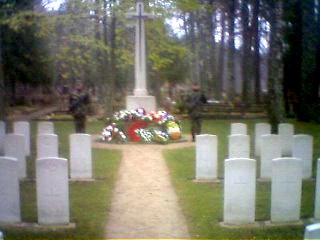
36 British soldiers and sailors
The British "Bed of Honour" is located within the large civil cemetary of Jelgava in Latvia and is, in my opinion, beautifully tended and cared for by Jelgava Council.
The 36 graves are in 4 lines within a separate plot and is marked by a war cross.
Most of the casualties died whilst in prisoner of war camps during ww1.
Over the next few days and weeks I will provide more details of the men buried in these graves .
I have also found 2 very different accounts of Remembrance Day ceremonies held in recent years, events which I have attended.
For practical reasons the dates of these postings have been changed to future dates ie 2007 to ensure the more relevant factual information stays on the first page.
I welcome any comments or feedback about these postings and especially contact with any families of these servicemen.
The 36 graves are in 4 lines within a separate plot and is marked by a war cross.
Most of the casualties died whilst in prisoner of war camps during ww1.
Over the next few days and weeks I will provide more details of the men buried in these graves .
I have also found 2 very different accounts of Remembrance Day ceremonies held in recent years, events which I have attended.
For practical reasons the dates of these postings have been changed to future dates ie 2007 to ensure the more relevant factual information stays on the first page.
I welcome any comments or feedback about these postings and especially contact with any families of these servicemen.
Wednesday, July 25, 2007
St Nikolai Cemetary's British servicemen A-C
- 9356 PTE ARCHER J KING'S OWN YORKSHIRE LT INFANTRY DIED 29/03/1917 AGE UNKNOWN.
- 6611 PTE ARGYLE S EAST SURREY REGT DIED 13/09/1917 AGE UNKNOWN.
- 10321 PTE BAKER FC BEDFORDSHIRE REGT DIED 06/08/1916 AGE UNKNOWN
- 8214 PTE BARLOW F WEST YORKS REGT-PRINCE OF WALES OWN 31/03/1917 AGE 32
- 7554 PTE BOYINGTON G WEST YORKSHIRE REGIMENT 22/04/1917 AGE UNKNOWN
- 18807 PTE BROWN JW HIGHLAND LIGHT INFANTRY DIED 22/03/1917 AGE 22
- 470563 RIFLEMAN CARRUTHERS HS LONDON REGT DIED 06/04/1917 AGE 20
- 6219 PTE CLARKE J SUFFOLK REGT DIED 14/09/1917 AGE UNKNOWN
- 4926 BANDSMAN CLARKIN WP LINCOLNSHIRE REGT DIED 28/04/1917 AGE 34


Thursday, July 27, 2006
British soldiers and seamen buried at Jelgava D-M

1.4901 PT FARMER JE COLDSTREAM GUARDS DIED 15/04/1917 AGE 33
2.9051 PTE GRANT JE HAMPSHIRE REGT DIED 12/05/1917 AGE 26
3.2295 PTE HARVEY J ROYAL WARWICKSHIRE REGT DIED 12/04/1917 AGE UNKNOWN
4.213465 ABLE SEAMAN IRELAND CS ROYAL NAVAL VOLUNTEER RESERVE DIED 26/03/1917 AGE UNKNOWN
5.7736 PTE IRVIN CA EAST SURREY REGT DIED 02/08/1916 AGE UNKNOWN
6.7577 PTE KINSMAN H NORFOLK REGT DIED 01/04/1917 AGE 28
7. 6474 PTE KNILL G WILTSHIRE REGT DIED 30/03/1917 AGE 34

9.8295 PTE McCULLOCH J SEAFORTH HIGHLANDERS DIED 17/04/1917 AGE UNKNOWN
10.2521 L/CPL MULHOLLAND T MANCHESTER REGT DIED 23/03/1917 AGE UNKNOWN
Subscribe to:
Posts (Atom)


 Posts
Posts